This is one of my favorite sights when grocery shopping, fresh fish ready to be filleted to order. Whatever it is, I always want it.
The selection on display this particular day was Hawaiian Opah, also known as Moonfish. Opah is very rarely caught by recreational fishermen, and is primarily bycatch for commercial fisheries that target tuna and mahi mahi. It's not a fish you're likely to see regularly offered for sale in your local market, so when you see it you should buy it.
Our fillet was cut from the top loin, which is sweet and lean with a texture somewhat like Tuna. With fish this fresh, a very simple preparation is best. We grilled it with a little lemon, salt and pepper, and fresh thyme and oregano. Served with a salad and quinoa, it was a fast, healthy meal. Brad put a little chopped fresh mint in the quinoa, which was a nice touch.
This was the best fish I've had in recent memory.
Opah!
Wine
We drank a Chardonnay from Chateau Montelena. I love Montelena's philosophy: "Make the best. Period." Shouldn't that be everyone's philosophy?
I'm actually not a big fan of Chardonnay. I'm obviously not in the ABC ("anything but Chardonnay") camp, but my palate has grown weary of the heavy, overdone way too oaky Chardonnay. Bleh. But Montelena produces a lovely french-style Chardonnay, with just the right amount of oak.
I've mentioned Chateau Montelena in a previous post, when we had their Riesling. Their Riesling is also excellent, but the Chardonnay is what made them -- and the Napa valley -- famous. Try it and you'll see why.
Friday, June 24, 2011
Wednesday, June 22, 2011
I Want My Baby Back, Baby Back, Baby Back, Baby Back, Bay-bee Back Ribs
I got you to sing that, didn't I? At least in your head, if not out loud.
No idea what I'm talking about? Check out this clip from the tv show Scrubs riffin' on the old Chili's commercial, so you can sing along with the rest of us.
Smoked Baby Back Ribs
1 rack baby back ribs
Team Sweet Mama's Kansas City Rub* from Savory Spice Shop (see Sources page)
1/3 cup apple cider
2 Tablespoons bourbon
Coat ribs with rub and let sit 4 hours, wrapped in foil. Prepare smoker using applewood. Mix apple cider and bourbon and put in a spray bottle. Smoke ribs for 4 hours at 225-250 degrees. Spray each hour with apple cider and bourbon mixture.
*Ingredients as listed on bottle: Sugar, salt, paprika, hickory smoke salt, black pepper, mistard, onion, celery, ginger, allspice, cayenne and spices.
Baked Beans
4 slices bacon, chopped
1/2 yellow onion, chopped
1 cup BBQ sauce
1/3 cup brown sugar
1/3 cup molasses
2/3 cup beer (we used Fat Tire)
1/3 cup bourbon
1 teaspoon dry mustard
1 teaspoon salt
1/8 teaspoon ground cloves
1/8 teaspoon ground nutmeg
1 15 oz can black beans
1 15 oz can great northern beans
1 15 oz can red kidney beans
2 Tablespoons tomato paste
Heat a cast iron pot on the stovetop over medium-high heat. Add bacon and cook, stirring frequently, until fat is rendered. Add onion and cook, stirring, until transclucent and soft, about 5 minutes. Add beer and bourbon and cook, stirring occasionally, until mixture is reduced by half.
Add remaining ingredients and place pot in smoker or put in 300 degree oven and cook until desired thickness, about 2 hours.
Corn on the Cob
Based on a recipe from the July/August issue of Everyday Food, this is how I would modify it to pair well with the ribs and baked beans.
2 ears corn on the cob, husks and silk removed
2 Tablespoons melted butter
1/2 teaspoon minced jalapeno
2 Tablespoons fresh cilantro, chopped
Kosher salt
Fresh ground pepper
Heat grill or grill pan over medium high. Lightly oil with canola oil. Grill corn, turning occasionally, until kernels are tender and the corn is charred in spots, about 15 minutes.
Meanwhile, mix remaining ingredients together in a small bowl. After corn is cooked, remove to a platter and spread butter mixture over the cobs.
No idea what I'm talking about? Check out this clip from the tv show Scrubs riffin' on the old Chili's commercial, so you can sing along with the rest of us.
Brad got a new toy last week, a Weber smoker. Since buying it he'd been mulling over the very important decision of what to make in the smoker's inaugural run. He settled on baby back ribs; I was delighted with his choice.
Smoked Baby Back Ribs with Baked Beans and Corn on the Cob
Brad's ribs were spectacular, and his baked beans were outstanding as well. Seriously, I think there's nothing this man can't make better than any professional chef out there. (Yes, Bobby Flay, I'm looking at you. Ready for a real throwdown?)
My corn on the cob, on the other hand, was "meh." Tasty enough, but I totally missed the flavor profile of the rest of the meal.
So in the recipe below I've swapped out a few ingredients. It's what I should have done with the corn, and what I will do next time. Even though the recipe I followed didn't tell me to.
Kathleen evolves as a chef.
Wine
Brad sort of wanted beer with the ribs, and typically the one who spends all afternoon cooking gets to call the shots on beverage. But I'd been longing to try some of the PlumpJack Syrah we'd brought back from Napa.
I reminded Brad that of our group I was the only one who hadn't gotten to try it, as they were at the winery tasting it while I was running 26.2 miles down the Silverado Trail. In the rain. Into a headwind. And then I had to listen to them go on and on about how this Syrah would be so perfect with bar-b-que.
We had wine. Yes, I'm shameless.
My corn on the cob, on the other hand, was "meh." Tasty enough, but I totally missed the flavor profile of the rest of the meal.
So in the recipe below I've swapped out a few ingredients. It's what I should have done with the corn, and what I will do next time. Even though the recipe I followed didn't tell me to.
Kathleen evolves as a chef.
Wine
Brad sort of wanted beer with the ribs, and typically the one who spends all afternoon cooking gets to call the shots on beverage. But I'd been longing to try some of the PlumpJack Syrah we'd brought back from Napa.
I reminded Brad that of our group I was the only one who hadn't gotten to try it, as they were at the winery tasting it while I was running 26.2 miles down the Silverado Trail. In the rain. Into a headwind. And then I had to listen to them go on and on about how this Syrah would be so perfect with bar-b-que.
We had wine. Yes, I'm shameless.
Smoked Baby Back Ribs
1 rack baby back ribs
Team Sweet Mama's Kansas City Rub* from Savory Spice Shop (see Sources page)
1/3 cup apple cider
2 Tablespoons bourbon
Coat ribs with rub and let sit 4 hours, wrapped in foil. Prepare smoker using applewood. Mix apple cider and bourbon and put in a spray bottle. Smoke ribs for 4 hours at 225-250 degrees. Spray each hour with apple cider and bourbon mixture.
*Ingredients as listed on bottle: Sugar, salt, paprika, hickory smoke salt, black pepper, mistard, onion, celery, ginger, allspice, cayenne and spices.
Baked Beans
4 slices bacon, chopped
1/2 yellow onion, chopped
1 cup BBQ sauce
1/3 cup brown sugar
1/3 cup molasses
2/3 cup beer (we used Fat Tire)
1/3 cup bourbon
1 teaspoon dry mustard
1 teaspoon salt
1/8 teaspoon ground cloves
1/8 teaspoon ground nutmeg
1 15 oz can black beans
1 15 oz can great northern beans
1 15 oz can red kidney beans
2 Tablespoons tomato paste
Heat a cast iron pot on the stovetop over medium-high heat. Add bacon and cook, stirring frequently, until fat is rendered. Add onion and cook, stirring, until transclucent and soft, about 5 minutes. Add beer and bourbon and cook, stirring occasionally, until mixture is reduced by half.
Add remaining ingredients and place pot in smoker or put in 300 degree oven and cook until desired thickness, about 2 hours.
Corn on the Cob
Based on a recipe from the July/August issue of Everyday Food, this is how I would modify it to pair well with the ribs and baked beans.
2 ears corn on the cob, husks and silk removed
2 Tablespoons melted butter
1/2 teaspoon minced jalapeno
2 Tablespoons fresh cilantro, chopped
Kosher salt
Fresh ground pepper
Heat grill or grill pan over medium high. Lightly oil with canola oil. Grill corn, turning occasionally, until kernels are tender and the corn is charred in spots, about 15 minutes.
Meanwhile, mix remaining ingredients together in a small bowl. After corn is cooked, remove to a platter and spread butter mixture over the cobs.
Monday, June 20, 2011
Will Sit for Cookies
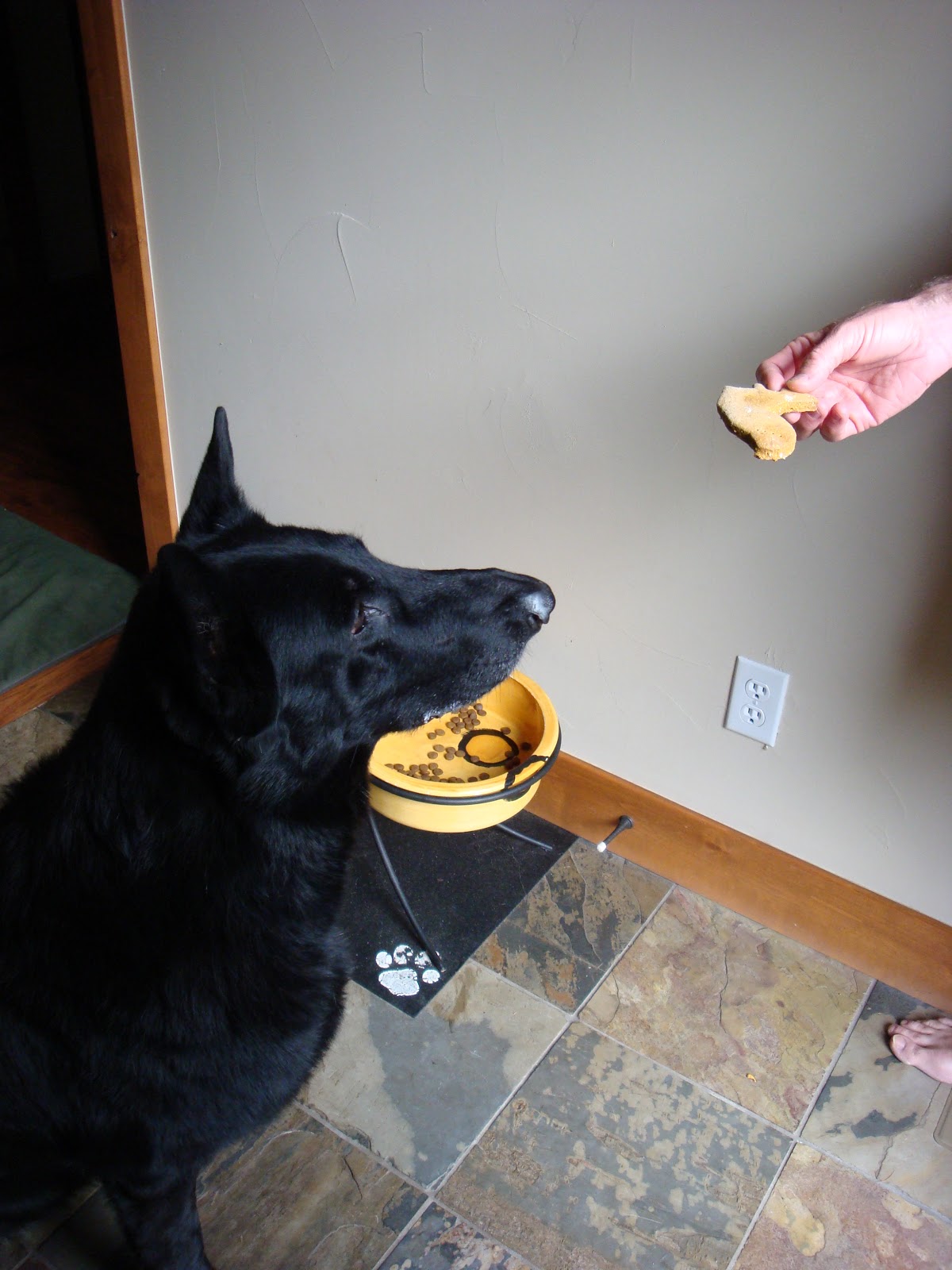
Everyone who lives in this house loves cookies, including Zorba (German Shepard) and Ruby (Rottweiler). Especially fresh from the oven.
Want your dog to think you are the best owner ever? Bake up some of these. They're not difficult, and will only take about an hour. And that includes time spent in the oven, during which time you can poke around here and read all my other blog entries.
An hour isn't that much time, considering how happy it'll make your dog, now is it? (Yes, your dog told me to say that. Feeling guilty yet?)
Peanut Butter, Pumpkin and Molasses Dog Treats
Zorba and Ruby both love treats; each other, not so much. So we had to conduct our taste testing in separate parts of the house.
Both gave these treats two paws up. Ruby would eat from the dumpster if we let her, but Zorba has a much more discerning palate. So with her approval, I think we have a winner.
And in case you're wondering, yes, I did taste the dough. And it was good. So I guess that makes it three paws up.
Update: Zorba and Ruby's cousin Blondie also loved these treats. Blondie is known to reject many treats, so the fact that she gobbled it up says a lot. Either it tasted really good or she just liked eating a Collie-shaped cookie. I'm going with it tasted good because that reflects best on me.
Peanut Butter, Pumpkin and Molasses Dog Treats
3 cups whole wheat flour
2 eggs
1 cup canned pumpkin
3/4 cup rolled oats
3 Tablespoons peanut butter
2 Tablespoons molasses
1/2 teaspoon salt
1/2 teaspoon ground cinnamon
1 Tablespoon water (more if necessary)
Preheat oven to 350.
Put all ingredients except water in the bowl of a food processor. With the machine running, add the water through the feed tube in a slow, steady stream, until dough holds together without being wet or sticky. Test by squeezing a small amount of the dough together. If it is too crumbly, add a little bit more water; if too sticky, add a little bit more flour.
Turn dough out onto a lightly floured surface. Roll the dough 1/4 inch thick, cut into desired shapes, and place on cookie sheets.
Bake until done (lightly browned and somewhat hard), about 40 minutes.
Want your dog to think you are the best owner ever? Bake up some of these. They're not difficult, and will only take about an hour. And that includes time spent in the oven, during which time you can poke around here and read all my other blog entries.
An hour isn't that much time, considering how happy it'll make your dog, now is it? (Yes, your dog told me to say that. Feeling guilty yet?)
Peanut Butter, Pumpkin and Molasses Dog Treats
Zorba and Ruby both love treats; each other, not so much. So we had to conduct our taste testing in separate parts of the house.
Both gave these treats two paws up. Ruby would eat from the dumpster if we let her, but Zorba has a much more discerning palate. So with her approval, I think we have a winner.
And in case you're wondering, yes, I did taste the dough. And it was good. So I guess that makes it three paws up.
Update: Zorba and Ruby's cousin Blondie also loved these treats. Blondie is known to reject many treats, so the fact that she gobbled it up says a lot. Either it tasted really good or she just liked eating a Collie-shaped cookie. I'm going with it tasted good because that reflects best on me.
Peanut Butter, Pumpkin and Molasses Dog Treats
3 cups whole wheat flour
2 eggs
1 cup canned pumpkin
3/4 cup rolled oats
3 Tablespoons peanut butter
2 Tablespoons molasses
1/2 teaspoon salt
1/2 teaspoon ground cinnamon
1 Tablespoon water (more if necessary)
Preheat oven to 350.
Put all ingredients except water in the bowl of a food processor. With the machine running, add the water through the feed tube in a slow, steady stream, until dough holds together without being wet or sticky. Test by squeezing a small amount of the dough together. If it is too crumbly, add a little bit more water; if too sticky, add a little bit more flour.
Turn dough out onto a lightly floured surface. Roll the dough 1/4 inch thick, cut into desired shapes, and place on cookie sheets.
Bake until done (lightly browned and somewhat hard), about 40 minutes.
Sunday, June 19, 2011
Beef: It's What's for Dinner
My 20 mile run yesterday was hard. Really hard. I blame the heat, as it was 81 degrees by the end, but it also could've just been because some runs are like that. They start off well, as this one did, then kick your ass. When I finished I stumbled into Jamba Juice feeling like I needed something, anything, in my body. And Jamba Juice was only steps away from my car in the parking lot where my running club met.
I'd never been to Jamba Juice before. Honestly, when I think of Jamba Juice I think of US Weekly photos of Britney Spears from her fat years, wandering around with a Jamba Juice in one hand and a cigarette in the other. Barefoot. And in places where one really shouldn't be barefoot.
I was so depleted that I found it impossible to navigate the crazy large menu in Jamba Juice. Knowing they had likely served several runners from my club that morning, I asked them to make me whatever the other runners had, and put some protein in it. The result was some kind of strawberry banana concoction. It was pretty good, but I won't be running back there anytime soon. (pun totally intended. ha.)
My instinct of "put some protein in it" was apparently my body screaming out for something it needed. Like the Bruce Willis-voiced baby in Look Who's Talking, tugging on his umbilical cord for Kirstie Alley to give him some apple juice.
When Brad made it home from his equally exhausting bike ride, he told me that during his tough final miles he'd decided he wanted a big, juicy steak for dinner.
Protein? Sold!
Dry Aged Rib Eye Steaks with Grilled Asparagus, Shallots and Potatoes
With steak on the menu, what to serve with it? I found this recipe in Everyday Food for grilled shallots and potatoes. I'd never had shallots prepared like this before, but I do love shallots and this looked really good. And it was. (recipe below)
Wine
To me, no steak should ever be eaten without a nice, bold red wine. Our choice was a Cabernet Sauvignon from Andrew Geoffrey Vineyards.
The backstory on this incredible wine really deserves it's own blog post.
Brad and I were in Napa last March for me to run the Napa Valley Marathon. Our friends Robin and Mark joined us for a few days because I'd somehow managed to snag a reservation for four at the French Laundry.
My friend Robin has exquisite taste in wine, and has introduced me to many that are now some of my favorites. I learned on this Napa trip that any winery Robin visits must require at least one U-turn and cannot have any obvious signage from the road. She's an expert on hidden gems, I guess you'd say.
So one day we're out touring Napa wineries and she phones a winery whose wine she likes to ask about a tasting. Her call is answered by the owner, who tells her he'd love to give us a tasting and we should meet him at the base of Diamond Mountain. Wow, the owner? That's pretty cool.
We go to the appointed spot to wait. And wait. I'm sure we didn't actually wait that long, it just seemed like a long time because we all were like "what the heck are we doing, waiting on the side of the road for a wine tasting?" Then a white SUV pulls up and the driver instructs us to follow him. So we did.
The road quickly reduced down to one twisty lane, which we took to the top of Diamond Mountain. I know I wasn't the only one riding in our car who had serious reservations about what Robin had gotten us into. We came to the end of the road and the guy in the white SUV opens a cattle gate. We all get out of the car because clearly the rest of this journey is to be on foot.
The guy tosses Mark a box of stemware, which Mark deftly catches, and then Mark trips and rolls down the hill. I don't know how he did it, but as he was tumbling ass over teakettle Mark managed to keep the box of glasses high above his head and not a single one was broken. Hurrah!
Thank goodness for that, because it would've been hard to do a tasting without any glasses. And I now know my life would never have been complete without tasting this man's wine.
We hike the rest of the way in to the "tasting room," which is a deck built above his 13 acres of Cabernet grapes that provides sweeping views of the entire Napa valley. He has a great picture of it here, on the winery's website. It was a bit chilly up there in early March, but we were warmed by some of the best Cabernet Sauvingon I've ever had. And the company of a friendly, interesting and engaging vineyard owner.
After our tasting, we all piled back in the car for the trek back down the mountain, chatting wildly about the fantastic experience Robin had just provided us all. And Robin admits that wasn't even the winery she was thinking of when she called for a tasting. Pure happenstance led us to the best wine tasting experience any of us ever had.
Thank you, Peter.
Dry Aged Rib Eye Steaks with Grilled Asparagus, Potatoes and Shallots
Based on a recipe from the July/August 2011 issue of Everyday Food.
2 dry aged Rib Eye steaks
Rosemary sea salt (or any kind of sea salt)
Chili powder
Onion Salt
Freshly ground black pepper
1 bunch asparagus, trimmed
Extra-virgin olive oil
Kosher salt
Freshly ground black pepper
Fresh mint, chopped
1/2 pound shallots, unpeeled
3/4 pound medium-sized russet potatoes, cut into 1 1/2 inch pieces
Extra-virgin olive oil
Kosher salt
Freshly ground black pepper
Heat grill to medium-high.
For the steaks, sprinkle each with rosemary sea salt, chili powder and onion powder. Grill until desired degree of doneness, then transfer to a plate, tent with foil and let rest for about 10 minutes before serving.
Place asparagus in a medium sized rectangular pan. Drizzle olive oil over top, and stir with hands to coat the asparagus. Sprinkle with salt and pepper. Cook in a grill pan, stirring occasionally, until done (slightly charred). Just before it's done, sprinkle the mint over the asparagus.
Place shallots and potatoes on a large double layer of foil lined with parchment paper. Drizzle with olive oil and season with salt and pepper. Fold parchment and foil around the vegetables and crimp edges to form a packet. Place packet on grill and cook, flipping once, for about 30 minutes. The shallots should be soft and the potatoes cooked through and crisp around the edges.
When Brad made it home from his equally exhausting bike ride, he told me that during his tough final miles he'd decided he wanted a big, juicy steak for dinner.
Protein? Sold!
Dry Aged Rib Eye Steaks with Grilled Asparagus, Shallots and Potatoes
With steak on the menu, what to serve with it? I found this recipe in Everyday Food for grilled shallots and potatoes. I'd never had shallots prepared like this before, but I do love shallots and this looked really good. And it was. (recipe below)
Wine
To me, no steak should ever be eaten without a nice, bold red wine. Our choice was a Cabernet Sauvignon from Andrew Geoffrey Vineyards.
The backstory on this incredible wine really deserves it's own blog post.
Brad and I were in Napa last March for me to run the Napa Valley Marathon. Our friends Robin and Mark joined us for a few days because I'd somehow managed to snag a reservation for four at the French Laundry.
My friend Robin has exquisite taste in wine, and has introduced me to many that are now some of my favorites. I learned on this Napa trip that any winery Robin visits must require at least one U-turn and cannot have any obvious signage from the road. She's an expert on hidden gems, I guess you'd say.
So one day we're out touring Napa wineries and she phones a winery whose wine she likes to ask about a tasting. Her call is answered by the owner, who tells her he'd love to give us a tasting and we should meet him at the base of Diamond Mountain. Wow, the owner? That's pretty cool.
We go to the appointed spot to wait. And wait. I'm sure we didn't actually wait that long, it just seemed like a long time because we all were like "what the heck are we doing, waiting on the side of the road for a wine tasting?" Then a white SUV pulls up and the driver instructs us to follow him. So we did.
The road quickly reduced down to one twisty lane, which we took to the top of Diamond Mountain. I know I wasn't the only one riding in our car who had serious reservations about what Robin had gotten us into. We came to the end of the road and the guy in the white SUV opens a cattle gate. We all get out of the car because clearly the rest of this journey is to be on foot.
The guy tosses Mark a box of stemware, which Mark deftly catches, and then Mark trips and rolls down the hill. I don't know how he did it, but as he was tumbling ass over teakettle Mark managed to keep the box of glasses high above his head and not a single one was broken. Hurrah!
Thank goodness for that, because it would've been hard to do a tasting without any glasses. And I now know my life would never have been complete without tasting this man's wine.
We hike the rest of the way in to the "tasting room," which is a deck built above his 13 acres of Cabernet grapes that provides sweeping views of the entire Napa valley. He has a great picture of it here, on the winery's website. It was a bit chilly up there in early March, but we were warmed by some of the best Cabernet Sauvingon I've ever had. And the company of a friendly, interesting and engaging vineyard owner.
After our tasting, we all piled back in the car for the trek back down the mountain, chatting wildly about the fantastic experience Robin had just provided us all. And Robin admits that wasn't even the winery she was thinking of when she called for a tasting. Pure happenstance led us to the best wine tasting experience any of us ever had.
Thank you, Peter.
Dry Aged Rib Eye Steaks with Grilled Asparagus, Potatoes and Shallots
Based on a recipe from the July/August 2011 issue of Everyday Food.
2 dry aged Rib Eye steaks
Rosemary sea salt (or any kind of sea salt)
Chili powder
Onion Salt
Freshly ground black pepper
1 bunch asparagus, trimmed
Extra-virgin olive oil
Kosher salt
Freshly ground black pepper
Fresh mint, chopped
1/2 pound shallots, unpeeled
3/4 pound medium-sized russet potatoes, cut into 1 1/2 inch pieces
Extra-virgin olive oil
Kosher salt
Freshly ground black pepper
Heat grill to medium-high.
For the steaks, sprinkle each with rosemary sea salt, chili powder and onion powder. Grill until desired degree of doneness, then transfer to a plate, tent with foil and let rest for about 10 minutes before serving.
Place asparagus in a medium sized rectangular pan. Drizzle olive oil over top, and stir with hands to coat the asparagus. Sprinkle with salt and pepper. Cook in a grill pan, stirring occasionally, until done (slightly charred). Just before it's done, sprinkle the mint over the asparagus.
Place shallots and potatoes on a large double layer of foil lined with parchment paper. Drizzle with olive oil and season with salt and pepper. Fold parchment and foil around the vegetables and crimp edges to form a packet. Place packet on grill and cook, flipping once, for about 30 minutes. The shallots should be soft and the potatoes cooked through and crisp around the edges.
Saturday, June 18, 2011
Pasta, Please
My training schedule for the San Francisco Marathon called for a 20 mile run this morning, so last night was pasta night. And not just any pasta, but Brad's super delicious baked rigatoni. I can (and did!) eat bowls and bowls of it.
Now Brad doesn't follow a recipe for this pasta, he just sort of whips it up on the fly. And I'm pretty sure each time he makes it it's a little bit different. But in the interest of our dear readers being able to replicate this in their very own kitchens, I annoyingly peered over his shoulder and took notes while he cooked. So, I guess I should say this is but one version of Brad's super delicious baked rigatoni. A darn good one, though.
All measurements and times are approximate. Reading that in a recipe would make me go "um, next." Hopefully I've included enough precision to adequately convey the essential components to others who are like me and, thankfully, the dish is itself pretty basic. Any mistakes in the recipe are mine.
Wine
Wine the night before a 20 mile run, you ask? Heck yeah, I say.
A good friend, and fellow marathoner, has a rule: No wine the night before speedwork or long runs. I tried it. It's not for me. She's a faster runner, so maybe there's something to it, but I'm ok with running a little slower and enjoying myself. I do restrain myself somewhat, having only one glass. Or maybe two.
We drank a wine from Montepulciano, a word I love almost as much as the wine itself. Say it with me: Montepulciano. Doesn't it sound . . . I don't know, so very Italian? There's just something about that word for me.
Anyway, ours was a Vino Nobile di Montepulciano Riserva from the Fanetti winery in Toscana-Montepulciano, Italy. It's primarily Sangiovese, blended with Canaiolo and Cabernet.
Tuscany is the heart and soul of Sangiovese and in Montepulciano, Sangiovese is known as Prunolo Gentile. The grapes are picked by hand and aged in large traditional wild chestnut oak casks called Botti for a minimum of two years (three for Riserva). Finetti ages its Vino Nobile in the oak casks five years before bottling.
Vino Nobile di Montepulciano was reportedly a favorite of Farnese Pope Paolo III, and was once considered the "king of all wines," meant only for royalty to drink.
Sounds about right for us.
Baked Rigatoni with Sausage and Mushrooms
28 oz can whole San Marzano tomatoes
1 Tablespoon extra-virgin olive oil
2 links Italian sausage (we use spicy, but sweet would also work)
4 large cloves garlic, chopped
1 1/4 c. sliced cremini mushrooms
1 fresh tomato, roughly chopped
2 sprigs fresh thyme
1/4 cup torn fresh basil
1/2 pound dry rigatoni, cooked according to package directions
1/2 an 8 oz container of ciliegine (little cherry size) fresh mozarella
1/2 cup Parmesan cheese
Preheat oven to 425.
With your hands, break up canned tomatoes in a medium bowl. Add chopped fresh tomatoes and set aside.
Begin water boiling for the rigatoni; you'll cook the rigatoni until just under al dente, a few minutes less than indicated on the package.
Heat a large saute pan with a tight-fitting lid over medium heat; add olive oil and swirl to coat pan. Remove sausage from casings and brown in pan, stirring often to crumble. Add mushrooms and thyme, and cook until mushrooms have softened. Remove sausage mixture from the pan and set aside.
Add garlic to the pan used to cook the sausage mixture and cook until fragrant, about 30 seconds. Add tomatoes, bring to boil; reduce heat and simmer approximately 5 minutes. Add basil and simmer for about 5 minutes; add sausage mixture back to pan and continue to simmer until rigatoni is done.
Drain pasta and put in a casserole or au gratin pan. Spoon sauce over the top, then stir to combine. Sprinkle grated Parmesan on top, and then scatter fresh mozarella balls on top of that.
Bake, uncovered, until done (cheese has melted and browned), about 15-20 minutes.
Now Brad doesn't follow a recipe for this pasta, he just sort of whips it up on the fly. And I'm pretty sure each time he makes it it's a little bit different. But in the interest of our dear readers being able to replicate this in their very own kitchens, I annoyingly peered over his shoulder and took notes while he cooked. So, I guess I should say this is but one version of Brad's super delicious baked rigatoni. A darn good one, though.
All measurements and times are approximate. Reading that in a recipe would make me go "um, next." Hopefully I've included enough precision to adequately convey the essential components to others who are like me and, thankfully, the dish is itself pretty basic. Any mistakes in the recipe are mine.
Wine
Wine the night before a 20 mile run, you ask? Heck yeah, I say.
A good friend, and fellow marathoner, has a rule: No wine the night before speedwork or long runs. I tried it. It's not for me. She's a faster runner, so maybe there's something to it, but I'm ok with running a little slower and enjoying myself. I do restrain myself somewhat, having only one glass. Or maybe two.
We drank a wine from Montepulciano, a word I love almost as much as the wine itself. Say it with me: Montepulciano. Doesn't it sound . . . I don't know, so very Italian? There's just something about that word for me.
Anyway, ours was a Vino Nobile di Montepulciano Riserva from the Fanetti winery in Toscana-Montepulciano, Italy. It's primarily Sangiovese, blended with Canaiolo and Cabernet.
Tuscany is the heart and soul of Sangiovese and in Montepulciano, Sangiovese is known as Prunolo Gentile. The grapes are picked by hand and aged in large traditional wild chestnut oak casks called Botti for a minimum of two years (three for Riserva). Finetti ages its Vino Nobile in the oak casks five years before bottling.
Vino Nobile di Montepulciano was reportedly a favorite of Farnese Pope Paolo III, and was once considered the "king of all wines," meant only for royalty to drink.
Sounds about right for us.
Baked Rigatoni with Sausage and Mushrooms
28 oz can whole San Marzano tomatoes
1 Tablespoon extra-virgin olive oil
2 links Italian sausage (we use spicy, but sweet would also work)
4 large cloves garlic, chopped
1 1/4 c. sliced cremini mushrooms
1 fresh tomato, roughly chopped
2 sprigs fresh thyme
1/4 cup torn fresh basil
1/2 pound dry rigatoni, cooked according to package directions
1/2 an 8 oz container of ciliegine (little cherry size) fresh mozarella
1/2 cup Parmesan cheese
Preheat oven to 425.
With your hands, break up canned tomatoes in a medium bowl. Add chopped fresh tomatoes and set aside.
Begin water boiling for the rigatoni; you'll cook the rigatoni until just under al dente, a few minutes less than indicated on the package.
Heat a large saute pan with a tight-fitting lid over medium heat; add olive oil and swirl to coat pan. Remove sausage from casings and brown in pan, stirring often to crumble. Add mushrooms and thyme, and cook until mushrooms have softened. Remove sausage mixture from the pan and set aside.
Add garlic to the pan used to cook the sausage mixture and cook until fragrant, about 30 seconds. Add tomatoes, bring to boil; reduce heat and simmer approximately 5 minutes. Add basil and simmer for about 5 minutes; add sausage mixture back to pan and continue to simmer until rigatoni is done.
Drain pasta and put in a casserole or au gratin pan. Spoon sauce over the top, then stir to combine. Sprinkle grated Parmesan on top, and then scatter fresh mozarella balls on top of that.
Bake, uncovered, until done (cheese has melted and browned), about 15-20 minutes.
Friday, June 17, 2011
Joy to the Fishes in the Deep Blue Sea
Joy to you and me.
Brad and I eat a lot of fish, particularly in the summer. When at the market, I typically look for whatever fish is fresh (not previously frozen) and wild caught (not farmed). Armed with my copy of Everyday Food in my purse, I selected Chilean sea bass, chose a recipe, then went off to find the other ingredients.
I try to be aware of sustainability issues, but have to admit I generally rely on signage posted in the fish case at Whole Foods. And the fact that I'm in Whole Foods, which isn't supposed to carry fish that's not sustainable. But before writing today's blog entry, I decided to find out more about the fish we had for dinner last night.
My first stop was the Monterey Bay Aquarium website, home of Seafood Watch and the recognized authority on seafood sustainability. To my surprise, Chilean sea bass is listed as "avoid."
Uh-oh.
Researching further, I discovered an interesting backstory on Chilean sea bass.
Now, all this happened in the not-too-distant past, which made me wonder how I missed it. Maybe I'm the only one who remained oblivious to the perils facing Chilean sea bass. But in case you missed it, too, here it is.
If you've had Chilean sea bass, you know what an incredibly delicious fish it is, with its silky, large-flake flesh. People love it. And in the 1990's, people apparently loved it a little too much, quickly making it overfished and endangered. So a group of about 1,000 chefs vowed to "Take a Pass on Chilean Sea Bass," a campaign that helped bring to light the issues regarding this beloved fish, and pulled it from their restaurant menus.
In 1999, Whole Foods Market stopped selling Chilean sea bass altogether. Then in 2006 it found a sustainable South Georgia Island fishery that was certified by the Marine Stewardship Council ("MSC"), and brought it back to stores.
One of the problems is most Chilean sea bass is caught using bottom longlines, which hook and drown thousands of sea birds each year. Another issue is Chilean sea bass is a very slow-growing species that takes nine or ten years to reach reproductive maturity, and can live 40 years. This makes it extremely vulnerable to overfishing.
MSC-certified Chilean sea bass fisheries don't use bottom longlines, and they fish in a territory where the Council has determined there is a healthy population of the fish. And according to their recertification (for October 2009 through October 2013), these MSC-certified fisheries are doing very well at maintaining the population and minimizing ecological impacts, achieving scores significantly higher than in the original certification.
However, only about 5% of Chilean sea bass sold worldwide is from MSC-certified fisheries, and it is still considered to be overfished outside the territory of the certified fisheries. Illegal and unreported fishing magnifies the problem, as pirate fisherman try to cash in on the high demand of this sought-after fish.
So, as my Public Service Announcement today, please always look for the MSC certification before buying Chilean sea bass. If certified sustainable Chilean sea bass is not available, there are several good alternatives: Striped bass, Pacific halibut and sablefish (black cod) from Alaska and British Columbia are listed in Seafood Watch as "best choices" and mahi mahi as a "good alternative".
Chilean Sea Bass with Tomatoes and Fennel
This is another recipe inspired by one in Everyday Food, the July/August 2011 issue. If you've made it this far, you've probably read enough, so I'll dispense with further chit-chat and get right down to it.
This was yummy. Recipe below.
Wine
Back to Rioja we went for this fish, with a white wine from R. Lopez de Heredia. Specifically, the Vina Gravonia. This wine is aged in barrels for four years before bottling, which is much longer than is typical for white wines. As you can see from the picture, we drank a 2000, and it was awesome. Over time the wine becomes very silky; almost sauternes-like, but without the sweetness.
Chilean Sea Bass with Tomatoes and Fennel
1 Tablespoon extra-virgin olive oil, plus more for drizzling
1 small fennel bulb, thinly sliced lengthwise (save fronds)
Kosher salt
Freshly ground black pepper
1 garlic clove, minced
2 large tomatoes, diced large
3/4 pound Chilean sea bass, cut into two portions
Heat a large skillet with a tight-fitting lid over medium; add olive oil and swirl to coat bottom of pan. Add fennel and cook, stirring frequently, until translucent, about 4 minutes. Season with salt and pepper.
Add tomatoes to the pan with the fennel and cook, stirring frequently, until the tomatoes soften and release their juices, 3 to 4 minutes. Nestle halibut in the tomato mixture and season again with salt and pepper. Cover and cook until the fillets are done (opaque throughout), about 8 minutes.
Serve fish and tomato mixture in a shallow bowl over couscous or quinoa. Sprinkle with reserved fennel fronds.
Brad and I eat a lot of fish, particularly in the summer. When at the market, I typically look for whatever fish is fresh (not previously frozen) and wild caught (not farmed). Armed with my copy of Everyday Food in my purse, I selected Chilean sea bass, chose a recipe, then went off to find the other ingredients.
I try to be aware of sustainability issues, but have to admit I generally rely on signage posted in the fish case at Whole Foods. And the fact that I'm in Whole Foods, which isn't supposed to carry fish that's not sustainable. But before writing today's blog entry, I decided to find out more about the fish we had for dinner last night.
My first stop was the Monterey Bay Aquarium website, home of Seafood Watch and the recognized authority on seafood sustainability. To my surprise, Chilean sea bass is listed as "avoid."
Uh-oh.
Researching further, I discovered an interesting backstory on Chilean sea bass.
Now, all this happened in the not-too-distant past, which made me wonder how I missed it. Maybe I'm the only one who remained oblivious to the perils facing Chilean sea bass. But in case you missed it, too, here it is.
If you've had Chilean sea bass, you know what an incredibly delicious fish it is, with its silky, large-flake flesh. People love it. And in the 1990's, people apparently loved it a little too much, quickly making it overfished and endangered. So a group of about 1,000 chefs vowed to "Take a Pass on Chilean Sea Bass," a campaign that helped bring to light the issues regarding this beloved fish, and pulled it from their restaurant menus.
In 1999, Whole Foods Market stopped selling Chilean sea bass altogether. Then in 2006 it found a sustainable South Georgia Island fishery that was certified by the Marine Stewardship Council ("MSC"), and brought it back to stores.
One of the problems is most Chilean sea bass is caught using bottom longlines, which hook and drown thousands of sea birds each year. Another issue is Chilean sea bass is a very slow-growing species that takes nine or ten years to reach reproductive maturity, and can live 40 years. This makes it extremely vulnerable to overfishing.
MSC-certified Chilean sea bass fisheries don't use bottom longlines, and they fish in a territory where the Council has determined there is a healthy population of the fish. And according to their recertification (for October 2009 through October 2013), these MSC-certified fisheries are doing very well at maintaining the population and minimizing ecological impacts, achieving scores significantly higher than in the original certification.
However, only about 5% of Chilean sea bass sold worldwide is from MSC-certified fisheries, and it is still considered to be overfished outside the territory of the certified fisheries. Illegal and unreported fishing magnifies the problem, as pirate fisherman try to cash in on the high demand of this sought-after fish.
So, as my Public Service Announcement today, please always look for the MSC certification before buying Chilean sea bass. If certified sustainable Chilean sea bass is not available, there are several good alternatives: Striped bass, Pacific halibut and sablefish (black cod) from Alaska and British Columbia are listed in Seafood Watch as "best choices" and mahi mahi as a "good alternative".
Chilean Sea Bass with Tomatoes and Fennel
This is another recipe inspired by one in Everyday Food, the July/August 2011 issue. If you've made it this far, you've probably read enough, so I'll dispense with further chit-chat and get right down to it.
This was yummy. Recipe below.
Wine
Back to Rioja we went for this fish, with a white wine from R. Lopez de Heredia. Specifically, the Vina Gravonia. This wine is aged in barrels for four years before bottling, which is much longer than is typical for white wines. As you can see from the picture, we drank a 2000, and it was awesome. Over time the wine becomes very silky; almost sauternes-like, but without the sweetness.
Chilean Sea Bass with Tomatoes and Fennel
1 Tablespoon extra-virgin olive oil, plus more for drizzling
1 small fennel bulb, thinly sliced lengthwise (save fronds)
Kosher salt
Freshly ground black pepper
1 garlic clove, minced
2 large tomatoes, diced large
3/4 pound Chilean sea bass, cut into two portions
Heat a large skillet with a tight-fitting lid over medium; add olive oil and swirl to coat bottom of pan. Add fennel and cook, stirring frequently, until translucent, about 4 minutes. Season with salt and pepper.
Add tomatoes to the pan with the fennel and cook, stirring frequently, until the tomatoes soften and release their juices, 3 to 4 minutes. Nestle halibut in the tomato mixture and season again with salt and pepper. Cover and cook until the fillets are done (opaque throughout), about 8 minutes.
Serve fish and tomato mixture in a shallow bowl over couscous or quinoa. Sprinkle with reserved fennel fronds.
Tuesday, June 14, 2011
Finding Balance
If you're like me and ate a little too much cake these past few days, this healthy meal may be just the ticket to get you back on track. Or eat this healthy meal to justify having another slice of cake. You know you want one. And, after all, isn't life about finding balance?
Cucumber and Mango Salad with Chili-Spiced Pork
This recipe comes from the June 2011 issue of Everyday Food, a Martha Stewart magazine.
I love this little magazine, which slips easily into my purse and so can be available when making game-time decisions on what to make for dinner. Most of the recipes in it are healthy, and they're all quick and easy to make.
Wine
We love Pinot with pork, and the Robert Sinskey Vineyards Los Carneros Pinot Noir was perfect. As I've written before, Robert Sinskey is one of my favorite Napa wineries. You gotta love a guy who produces a fantastic Pinot in the middle of Cab country.
Cucumber and Mango Salad with Chili-Spiced Pork
If you prefer, you can use chicken or turkey breast in place of the pork.
2 boneless pork loin chops
Kosher salt
Freshly ground black pepper
2 Tablespoons extra-virgin olive oil
1 1/2 teaspoons chili powder
4 teaspoons honey
2 Tablespoons fresh lime juice
1 Champagne mango, pitted, peeled and cut into 1-inch pieces
1/2 English cucumber, cut into 1-inch pieces
1 small head romaine lettuce, roughly chopped
Rinse and pat pork dry; season to taste with salt, pepper and 1 teaspoon chili powder. Grill until done (browned and pork is cooked through), turning once, about 10 minutes. Transfer to plate, cover loosely with foil and let rest while preparing the salad.
In a large bowl, whisk together olive oil, 1/2 teaspoon chili powder, honey, and lime juice. Season to taste with salt and pepper. Add mango, cucumber and lettuce and toss to combine.
Subscribe to:
Posts (Atom)